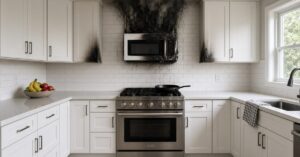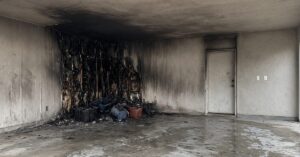
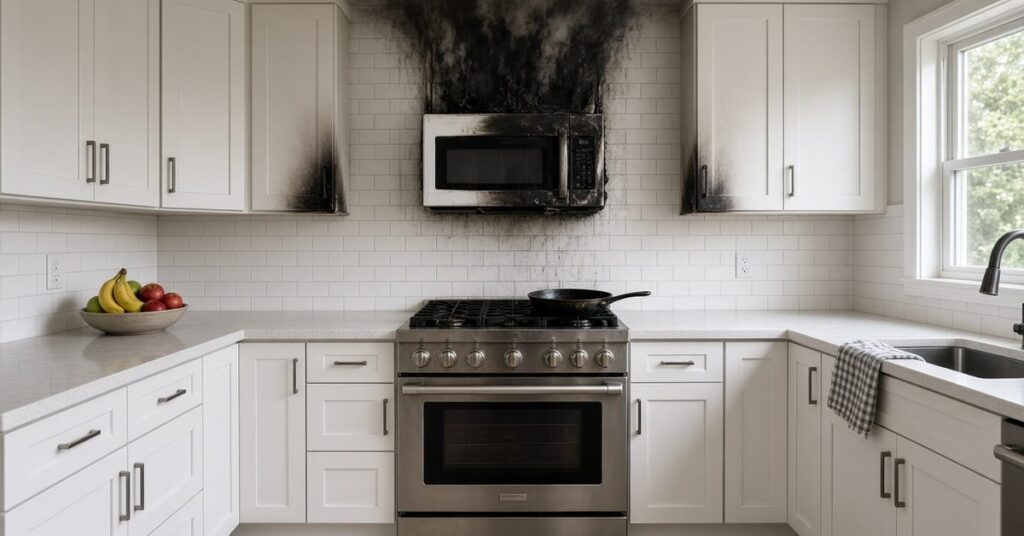
Most house fires start in the kitchen. A pan of oil left a minute too long, a dish towel too close to a burner, an old appliance with a bad cord. By the time the smoke alarm goes off and the fire is out, the flames themselves may have only touched a few feet of cabinet and wall.
Then you look around and realize the whole house smells like smoke, there is a gray film on the ceiling two rooms away, and the kitchen you cooked dinner in last night is unusable.
We have been through a lot of kitchens after a fire, and the question homeowners ask us most is simple: what can be saved, and what has to go? Here is how we walk people through it.
The Damage Goes Farther Than the Burn Marks
Fire damage comes in layers. The first layer is the obvious one, the charred cabinets, the melted range hood, the scorched drywall behind the stove. That part is easy to see and easy to scope.
The second layer is smoke and soot. Smoke rises, spreads, and follows air currents through the house. It gets pulled into hallways, bedrooms, closets, and especially the HVAC system. Soot settles on every surface it reaches, and it is not just dirt. It is acidic, and over days and weeks it can etch countertops, tarnish fixtures, discolor grout, and yellow painted walls.
Kitchen fires add a third layer that surprises people. When food burns, especially meat or anything greasy, it creates what we call a protein fire. The residue is almost invisible, a thin sticky film you can barely see, but the odor is intense and clings to everything. Homeowners often wipe down a room, think it looks clean, and still cannot get rid of the smell. That is protein residue, and it takes specific cleaning methods to remove.
The fourth layer is water. If the fire department came out, there is almost always water in the cabinets, under the flooring, and inside the walls. That needs to be dried properly before any rebuilding starts.
What to Do in the First Few Days
- Keep the HVAC off. Running the system pulls soot through the ductwork and spreads it to every room in the house.
- Don’t scrub the soot yourself. Wiping soot with a wet rag or household cleaner smears it into paint and porous surfaces, which can turn a cleanable wall into one that needs replacing.
- Leave the electrical alone. Outlets and wiring near the fire need to be checked before anything in that area gets turned back on.
- Toss exposed food. Anything that was open, in the pantry near the fire, or in a fridge that lost power should go.
- Document everything. Photos of every room, including the ones that look fine, help your insurance claim.
- Secure the house if needed. If windows were broken or the fire vented through the roof, the home should be boarded up and tarped.
What Fire Damage Restoration Actually Involves
A proper fire damage restoration job starts with a full walkthrough of the house, not just the kitchen. We check how far the smoke traveled, test surfaces for soot, and look inside cabinets, attics, and ductwork where residue hides.
From there, the work splits into two tracks. Anything badly burned or structurally compromised comes out: charred drywall, damaged framing, cabinets that burned through. Everything else gets cleaned. Soot removal is done with dry sponges, specialized cleaners, and HEPA vacuums, matched to each surface so nothing gets damaged in the process.
Smoke odor removal is its own step. Cleaning surfaces takes care of most of it, but smoke works its way into drywall, insulation, and wood framing. Thermal fogging, hydroxyl generators, and sealing primers on affected framing are how that lingering smell actually goes away instead of coming back on the first humid day.
What Usually Gets Saved and What Doesn’t
Cabinets are the big decision. Solid wood cabinets with light smoke damage can often be cleaned and refinished. Particleboard and MDF boxes, which most builder-grade kitchens use, soak up smoke and odor and usually need to be replaced, even if they look fine from the outside.
Countertops often survive. Granite usually cleans up well. Quartz can discolor or crack from direct heat. Laminate near the fire is usually a loss.
Appliances that were near the flames typically get replaced. Even ones farther away can have soot pulled inside through cooling vents.
Flooring depends on the water. Tile on a slab usually survives. Wood and laminate that took water from the fire hose often do not.
Turning the Rebuild Into a Kitchen You Want
Here is the part people don’t expect. Once the damaged materials are out, you are standing in a kitchen that is partly stripped down already. Walls are open. Cabinets are gone. That is a natural point to decide whether you want the kitchen put back exactly the way it was, or whether this is the time to fix what always bothered you.
Maybe the island was too small, the pantry never worked, or the lighting was always dim. Insurance typically pays to restore what you had. If you want to change the layout or upgrade finishes, you cover the difference, but you are not paying twice for demolition and framing work that already has to happen. Because we handle both the restoration and the remodeling services, one team manages the whole project, from the first soot cleanup to the final cabinet pull.
Local Help When You Need It
We handle fire damage repair and kitchen rebuilds across the area, from older homes in New Braunfels to newer neighborhoods out in Helotes. If you have had a kitchen fire, call us at (210) 774 6486. We answer 24/7, and we can walk you through what comes next before you make any decisions about your home.