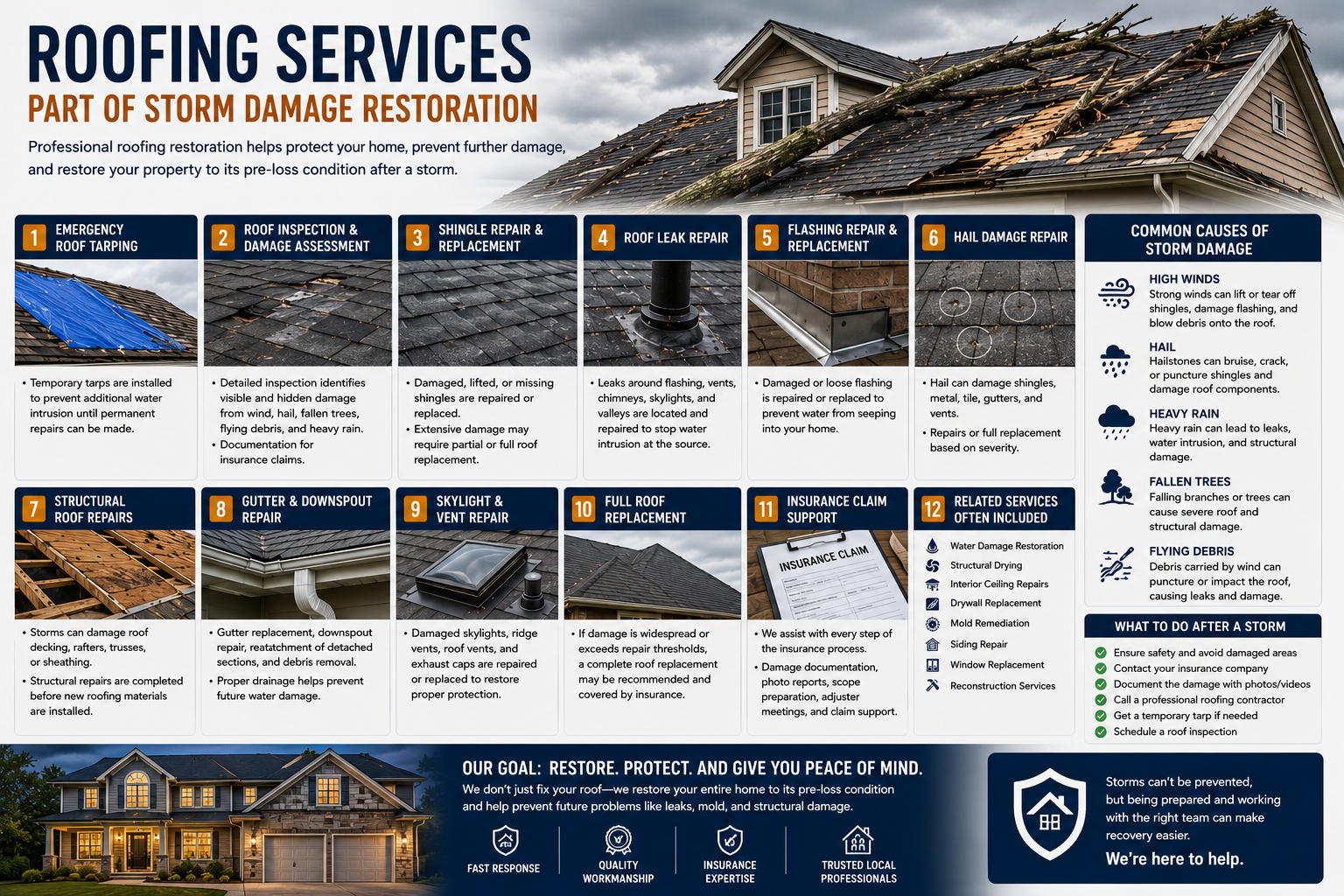
Storm damage restoration that includes roofing covers emergency tarping to stop active water intrusion, full damage assessment of the roof surface and attic, coordination with the insurance adjuster on scope and cost, permanent repair or replacement of the roof system, and integration of the roofing scope with the interior damage scope in a single insurance claim. This is different from calling a roofer who assesses and replaces the roof surface without addressing the interior water damage that entered through the compromised roof.
Understanding the difference between a roofer and a restoration company that includes roofing determines whether you get a complete or a partial recovery from a storm loss.
Emergency Tarping: The First Roofing Action
When a storm compromises the roof surface through wind damage, hail impact, or debris penetration, the first roofing action is emergency tarping to stop additional water from entering through the breach. Tarping is a temporary protective measure, not a repair, and it is covered under most homeowner policies as an emergency mitigation expense.
Tarping done correctly protects the structure and the insurance claim. A roof breach left unsecured through the next rain event adds weather-related secondary damage to the original storm loss. Insurance companies can dispute the portion of the claim attributable to secondary damage that occurred because the breach was not secured.
Dwyer Restoration deploys emergency tarping for storm damage in Boerne and the surrounding communities as a same-day service when a significant storm event creates a roof breach. The tarping documentation is included in the storm damage file and submitted to the adjuster as part of the emergency mitigation scope.
Full Damage Assessment: Roof Surface and Attic
A complete storm damage assessment covers the roof surface for hail impact, wind seal failures, and flashing damage, and the attic for evidence of water intrusion that may have occurred before or during the storm. Hail impact on asphalt shingles produces identifiable patterns of granule displacement and mat bruising that are distinct from normal aging. Wind damage produces specific seal failure and displacement patterns. Both are documented with photographs and measurements that establish the storm-specific damage clearly.
The attic assessment is where storm damage evidence that is not visible from the roof surface is found. Water staining on the underside of sheathing, wet or displaced insulation, and early deterioration of structural components all provide evidence of the impact and duration of water intrusion.
Homeowners in Bulverde and Camp Bullis who had storm damage but are uncertain whether it rises to the level of a claim benefit from a full assessment that documents the damage clearly before the adjuster visits. The assessment documentation gives the adjuster the evidence needed to evaluate the claim accurately rather than making the determination based on a visual inspection from the ground.
How Roofing Fits Into the Insurance Claim
Roofing and interior restoration are separate components of the same storm damage claim. The roof replacement or repair is the dwelling coverage component. The interior water damage from rain intrusion through the storm-created breach is also a dwelling coverage component. Both are part of the same covered storm event and should be documented and claimed together under a single consistent evidence base.
Calling a roofer for the roof and a separate restoration company for the interior creates two separate documentation sets that may conflict, have timeline inconsistencies, or attribute the same damage differently. This complicates the claim and can create coverage disputes that delay payment.
Dwyer Restoration handles both the roofing scope and the interior restoration scope for storm damage losses across Canyon Lake and the Hill Country service area. One team, one documentation package, one adjuster relationship, one claim that covers the full scope of the loss from the roof surface through the interior reconstruction.
Roof Replacement vs. Roof Repair
The determination of whether a storm-damaged roof requires repair or full replacement depends on the age and condition of the existing system, the extent and distribution of the storm damage, and the policy terms including whether replacement cost or actual cash value applies.
Full replacement is typically warranted when: hail impact is distributed across the full roof surface with no unaffected sections, the existing system is at or near the end of its useful life, or wind damage affected enough of the roof that selective repair would leave significant mismatched sections that compromise the system integrity.
Selective repair is appropriate when damage is limited to specific sections, the existing system is in good condition, and the repaired sections can be matched to the existing material without creating a patchwork that affects performance.
Texas Hail and What It Does to Roofing Systems
The San Antonio and Hill Country area sits in a hail-active corridor that produces some of the largest hail events in Texas on a regular basis. Large hail impacts asphalt shingles with enough force to bruise the mat beneath the surface granules, eliminating UV protection and weather resistance in the impacted areas without creating immediate visible damage from the ground.
Properties in Alamo Heights that experienced a significant hail event should have a professional roof assessment done even if the roof appears intact from the driveway. The impact damage that produces future leaks is the damage that is not visible without access to the roof surface and the attic.
Frequently Asked Questions
Q: What roofing services are included in storm damage restoration?
A: Storm damage restoration that includes roofing covers emergency tarping, full damage assessment of the roof surface and attic, insurance coordination on roofing scope and cost, and permanent repair or replacement as part of the integrated restoration claim. A restoration company that handles both roofing and interior damage documents both scopes under a single consistent evidence base, producing a more complete and less disputed claim than having two separate vendors document the same loss independently.
Q: Should I call a roofer or a restoration company after storm damage?
A: For losses that involve both roof damage and interior water intrusion, a restoration company that includes roofing as part of its integrated scope produces a better claim outcome than calling a roofer for the roof and a separate restoration company for the interior. The documentation from one team is consistent, the timeline is aligned, and the adjuster has one point of contact rather than two independent vendors providing potentially conflicting information about the same loss event.
Q: Does insurance cover roof replacement after a Texas hailstorm?
A: Standard homeowner policies cover hail damage to the roof as a sudden storm event. Texas policies with percentage-based wind and hail deductibles calculate the out-of-pocket amount as a percentage of the home’s insured value rather than a flat dollar amount. Older roofs may be settled at actual cash value rather than replacement cost depending on policy terms. A professional damage assessment that documents storm-specific impact gives the claim its strongest basis regardless of the policy’s settlement method.
Q: How long does roof replacement after storm damage take?
A: Emergency tarping happens on the day of the call. Insurance-approved replacement begins after adjuster review and scope approval, typically within one to two weeks of claim filing for standard residential losses. The replacement itself takes one to three days depending on the roof size and material. Total time from storm event to completed new roof ranges from two to four weeks for a straightforward residential loss with prompt insurance approval.
Storm or hail damage to your roof? Dwyer Restoration handles the full scope from emergency tarping through insurance-approved replacement across Boerne, Bulverde, Canyon Lake, Alamo Heights, and Camp Bullis. Call now.