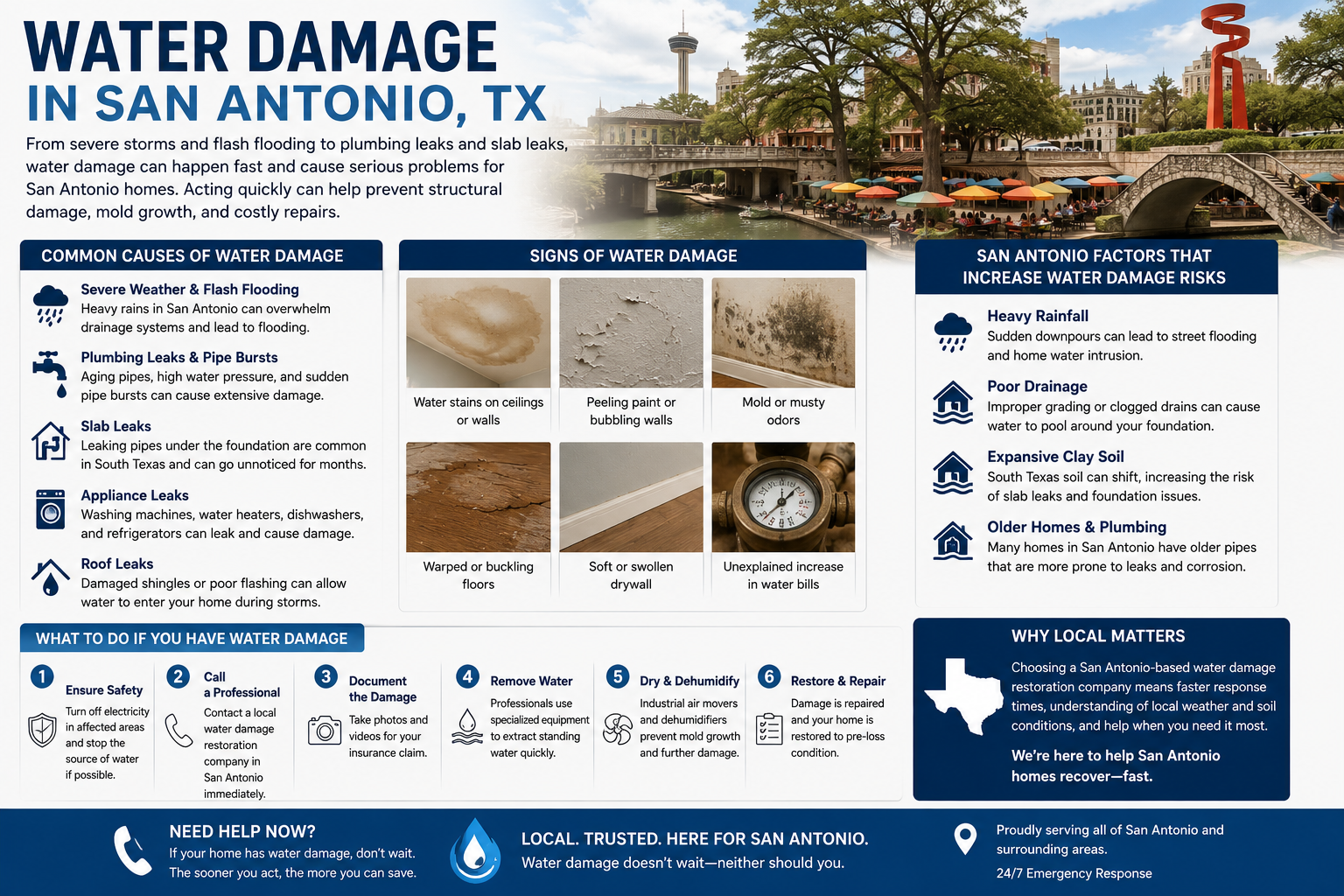
Water damage in Hill Country properties behaves differently from water damage in standard suburban construction for three main reasons: the prevalence of slab-on-grade and pier-and-beam construction common in rural and semi-rural properties, the flash flooding patterns specific to the region, and the soil types across the Edwards Plateau that affect drainage and foundation moisture behavior. Understanding these regional factors changes both the restoration approach and the timeline.
Homeowners in Boerne, Bulverde, Canyon Lake, and the communities northwest of San Antonio see water damage patterns that are specific to this geography. Here is what those patterns look like and what proper restoration requires.
Flash Flooding and What It Does to a Property
The Hill Country is one of the most flash-flood-prone regions in the United States. The thin soil layer over impermeable limestone creates rapid runoff during heavy rain events. Creeks and low-water crossings that appear harmless in dry conditions can reach dangerous levels within minutes of a storm cell moving through. Properties in low-lying areas or near drainage features can take on water faster than most homeowners expect.
Flash flood water is not clean water. It carries soil, debris, sewage from overwhelmed systems, agricultural runoff, and other contaminants along its path. Properties flooded by flash flood water require category three water remediation protocols: every porous material the water contacted is treated as contaminated regardless of how the water appeared.
Homeowners in Canyon Lake and the surrounding Guadalupe River corridor are familiar with this pattern. The combination of steep terrain, thin soil, and summer thunderstorm activity creates flash flood conditions that move fast and leave behind water that requires professional remediation, not just cleanup.
Pier-and-Beam Construction and Water Damage
Many older properties in the Hill Country and San Antonio area were built on pier-and-beam foundations rather than concrete slab. Pier-and-beam construction creates a crawl space beneath the living area that is directly exposed to ground moisture and flood water. Water that enters the crawl space saturates the subfloor sheathing and floor joists from below, working upward into the living space through the floor system before it is visible from inside the home.
Restoring pier-and-beam construction after a water event requires assessment and treatment of the crawl space, not just the living area above it. Crawl space remediation includes extraction of standing water, treatment of contaminated materials, drying of the subfloor assembly, and replacement of the vapor barrier that was damaged or displaced by the water event.
Properties in Bulverde and the surrounding communities with older construction frequently have crawl space moisture issues that compound after a flooding event. Dwyer Restoration’s assessment process includes the crawl space as a standard checkpoint for any property with pier-and-beam construction, because the damage below the floor is often more significant than the visible damage inside the home.
Slab Foundations and Hydrostatic Pressure
Properties on slab foundations in the Hill Country face a different challenge: the limestone geology creates drainage patterns that can direct significant water toward a foundation during heavy rain events. Hydrostatic pressure from saturated soil pushes water up through cracks and control joints in the slab, through perimeter gaps where the slab meets the wall, and through any other pathway that exists between the saturated exterior and the interior slab surface.
This type of intrusion is slow and often mistaken for a plumbing leak. The water appears to be coming up from the floor rather than entering from above. Correct diagnosis requires a moisture assessment that distinguishes slab intrusion from plumbing failure, because the remediation approach for each is different.
Homeowners in Boerne and Alamo Heights dealing with recurring moisture in finished basements or on slab floors after rain events should have a professional moisture assessment done to determine the actual water pathway before assuming the source and attempting DIY remediation.
Why Texas Heat Affects the Drying Timeline
San Antonio and the surrounding Hill Country has some of the warmest and most humid summer conditions in Texas. High ambient temperature and humidity affect the drying process in two ways: warm temperatures accelerate mold growth, shortening the window between water damage and the onset of microbial activity, and high humidity slows drying by reducing the moisture gradient between wet materials and the surrounding air.
Professional drying equipment in this environment must be sized for the actual ambient conditions, not for a generic drying scenario. Dehumidifiers that are sufficient in a drier or cooler climate may be underpowered for a summer water damage event in the San Antonio area.
Dwyer Restoration’s teams serving Alamo Heights and the broader San Antonio metropolitan area account for local ambient conditions when sizing and placing drying equipment. Daily moisture readings confirm that drying is actually progressing, not just that the equipment is running.
Flash Flood Insurance vs. Homeowners Insurance
This is the coverage gap that catches Hill Country homeowners most often. Standard homeowner policies cover sudden and accidental water damage from plumbing failures and appliance leaks. They do not cover flooding from outside the home. Flood damage requires separate flood insurance, typically through the National Flood Insurance Program.
A Hill Country property flooded by flash flood runoff is experiencing a flood event for insurance purposes, not a water damage event covered by the homeowner policy. Homeowners without separate flood coverage bear the full cost of restoration from a flash flood loss.
Dwyer Restoration serves property owners in Camp Bullis and the surrounding military and residential communities with full insurance coordination for both homeowner policy and flood insurance claims. Understanding which coverage applies to each component of the loss determines how the claim is structured and what documentation each carrier needs.
Frequently Asked Questions
Q: How does water damage in Hill Country properties differ from standard situations?
A: Hill Country properties face specific water damage patterns from flash flooding, pier-and-beam construction that allows water to affect the crawl space before the living area, limestone geology that directs hydrostatic pressure toward slab foundations, and summer heat and humidity that accelerate mold growth and complicate drying. Each of these factors affects the restoration approach and timeline in ways that a generic protocol designed for standard suburban construction does not fully address.
Q: Is flash flood damage covered by homeowners insurance in Texas?
A: No. Flash flood damage requires separate flood insurance, typically through the National Flood Insurance Program. Standard homeowner policies cover sudden and accidental internal water events like plumbing failures but explicitly exclude flooding from outside the home regardless of the cause. Hill Country properties in flood-prone areas should carry both homeowner and flood policies with coverage levels appropriate for their specific location and flood risk.
Q: How do you dry out a pier-and-beam home after flooding?
A: Proper drying of a pier-and-beam home after flooding requires assessment and treatment of the crawl space as well as the living area above it. The crawl space must be extracted, contaminated materials removed, the subfloor assembly dried to documented dry standard, and the vapor barrier replaced. Treating only the living area without addressing the crawl space leaves a persistent moisture source directly below the floor that will produce mold and structural deterioration regardless of how well the interior is dried.
Q: How quickly does mold grow after water damage in San Antonio?
A: In San Antonio’s warm and humid summer conditions, mold can begin growing on wet building materials within twenty-four hours, at the lower end of the twenty-four to forty-eight hour range used for more temperate climates. The combination of warm temperatures, high ambient humidity, and saturated organic building materials creates near-ideal conditions for rapid mold establishment. Professional extraction and industrial drying within the first few hours of a water event is the most reliable prevention.
Water damage in Boerne, Bulverde, Canyon Lake, Alamo Heights, or Camp Bullis? Call Dwyer Restoration for certified same-day response with regional expertise in Hill Country property restoration.