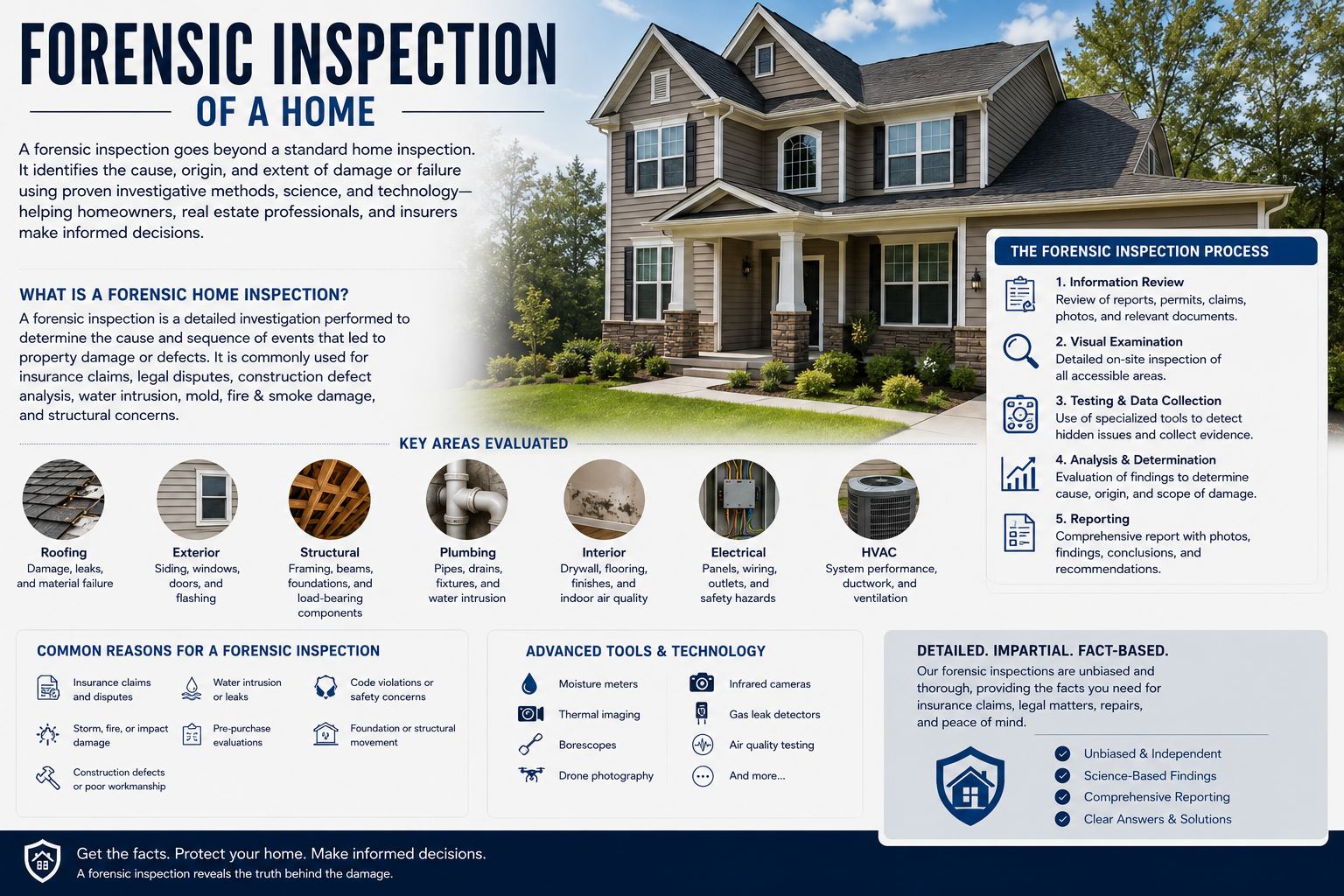
A forensic inspection for property damage is a systematic investigation that determines the cause, origin, timeline, and full extent of damage to a property using physical evidence, material analysis, documentation review, and professional expertise. It goes beyond a standard damage assessment to establish not just what is damaged but how and why it happened, when it began, and what the sequence of events was. Forensic inspection findings are used to support insurance claims, resolve coverage disputes, prepare for litigation, and establish factual baselines in complex damage scenarios.
Property owners encounter the need for forensic inspection most often when an insurance claim is disputed, when the cause of damage is unclear, or when multiple parties have conflicting interpretations of what happened.
When Is a Forensic Inspection Needed?
The most common situations that require forensic inspection are insurance coverage disputes where the insurer questions whether the damage falls under a covered cause, subrogation situations where the responsible party for the damage needs to be established, construction defect claims where the damage may trace back to faulty work rather than a covered event, and complex losses where multiple contributing factors need to be disentangled to determine what each party’s liability is.
A property owner whose water damage claim is being denied on the grounds that the moisture was from a pre-existing condition rather than a sudden event needs forensic documentation that establishes the actual cause and timeline. An adjuster’s determination is not automatically final when there is factual disagreement about how the damage occurred.
Dwyer Restoration’s forensic inspection and consultation services serve property owners across Alamo Heights and the broader San Antonio area who are dealing with disputed claims or complex damage scenarios that require a higher level of evidence than a standard assessment provides.
What Forensic Inspection Involves
A forensic property inspection uses a combination of physical assessment, material sampling, moisture history analysis, thermal imaging, and documentation review to reconstruct what happened. The inspector examines the damage patterns, the material condition, the building systems, and any available maintenance or inspection records to establish a factual timeline.
For water damage, forensic inspection can determine whether moisture originated from a sudden event or from long-term accumulation by examining the degradation patterns in affected materials, the growth stage of any mold present, and the moisture content distribution throughout the structure. These factors tell a story about duration that current moisture readings alone cannot establish.
Forensic Inspection vs. Standard Damage Assessment
A standard damage assessment documents what is damaged and what restoration is needed. A forensic inspection determines why the damage occurred, when it began, and whether it falls within or outside of the covered cause being claimed. Standard assessment produces a restoration scope. Forensic inspection produces an evidence record that supports or challenges a specific factual interpretation of the loss.
For property owners in Boerne dealing with an insurance dispute about whether their water damage resulted from a sudden covered event or from gradual moisture accumulation, a forensic inspection by a qualified consultant produces the documentation that addresses the dispute with evidence rather than with competing narratives.
How Forensic Findings Support an Insurance Claim
When an insurance claim is disputed, the burden of demonstrating that the damage falls within the covered cause rests on the property owner. Forensic documentation that clearly establishes the cause, origin, and timeline of the damage gives the property owner a factual record that can be reviewed by the insurance company, submitted to an appraisal process, or used in litigation if the dispute is not resolved through the claim process.
Adjusters who receive forensic inspection reports prepared by qualified consultants take them seriously because they represent a higher standard of documentation than a general damage assessment. A forensic finding that contradicts the adjuster’s initial determination gives the property owner grounds for a formal appeal with supporting evidence.
Homeowners in Bulverde and Camp Bullis who have received partial claim denials or coverage disputes benefit from understanding that a forensic inspection is available as a legitimate tool for challenging those determinations with physical evidence rather than accepting a disputed outcome without recourse.
Forensic Inspection in Construction Defect Claims
When property damage may trace back to construction defects rather than a covered weather or plumbing event, forensic inspection establishes the connection between the defect and the damage. This is relevant for newer construction where damage appears within the warranty period, for properties where water intrusion patterns suggest a building envelope failure rather than a plumbing event, and for situations where multiple parties including the builder, the insurer, and the property owner each have different explanations for the same damage.
Dwyer Restoration’s forensic consultation services in Canyon Lake and the surrounding Hill Country communities address both standard damage restoration and the complex multi-party situations that forensic inspection is specifically designed to resolve. The same organization that restores the property can also document the cause with the precision that complex claims require.
Frequently Asked Questions
Q: What is a forensic inspection for property damage?
A: A forensic property inspection is a systematic investigation that establishes the cause, origin, timeline, and full extent of property damage using physical evidence, material analysis, moisture history, and documentation review. It goes beyond standard assessment to answer not just what is damaged but how and why, establishing a factual record that supports insurance claims, resolves coverage disputes, and provides the evidence base for litigation when disputes cannot be resolved through the claim process.
Q: When do I need a forensic inspection for my property damage claim?
A: Forensic inspection is needed when an insurance claim is denied or disputed based on the cause of damage, when the adjuster’s determination about whether damage was sudden or gradual conflicts with the property owner’s account, when damage may trace back to a construction defect, or when multiple parties have conflicting explanations for the same loss. A forensic inspection provides the physical evidence record that addresses these disputes factually rather than through competing narratives.
Q: Can a forensic inspection overturn an insurance claim denial?
A: Forensic inspection findings that establish a covered cause for disputed damage give the property owner grounds for a formal appeal with supporting evidence. They do not automatically overturn a denial, but they provide the basis for challenging the denial through the policy’s internal dispute process, an independent appraisal, or litigation. Adjusters take forensic reports from qualified consultants seriously because they represent a higher standard of documentation than general assessment.
Q: How long does a forensic property inspection take?
A: The on-site inspection portion typically takes several hours for a residential property, depending on the complexity of the damage and the number of systems involved. The full process including material analysis, documentation review, and preparation of the written report typically takes several days to weeks depending on the complexity of the case and any laboratory testing required for material samples. Timeline varies significantly based on case complexity.
Disputed insurance claim or complex damage situation in the San Antonio area? Dwyer Restoration provides forensic inspection and consultation services. Call now for an assessment that goes beyond the surface.